
[Research Study] How Many Words is The Average Blog Post?
Written by 

This is a question that I get a lot: what's the average word count of blog posts? Some people want to know what to strive for, and others want to know what they are up against so they can write a blog post that is above the average word count. In either case, to get an idea of the average length of word count, I'll need a large data set, which is difficult to acquire for a handful of reasons:
- I'll need several enterprise-level programs to scrape, post-process, and harvest statistics.
- I'll need the ability to scrape specific blog footprints without hitting captchas on search engines.
- I'll need a large amount of proxy IP addresses so I don't get blocked.
- I'll need to organize and display the data in a way that is easy to digest.
- I'll need to filter out spam sites and anomalies with abnormally high word counts (such as groups of syndicated posts or comment spam posts).
- I'll need to filter out broken pages and redirected pages.
- I'll need a reasonably large data set size that won't crash Scrapebox, Screaming Frog, or Excel.
- I'll need to wait a long, long time while these scrapers get to work scouring the internet.
- I'll need to wait longer for the web page scraper to fetch the word count of each of those pages.
So, I set to work and scraped a list of 28,829 blog posts. The first 12,412 of them are blog posts that were published in 2019, and the remaining 16,417 blog posts were published on dates ranging from 2011 to 2015. I thought it would be interesting to compare data sets from recently published posts to posts that were published 4-8 years ago to see what's changed, if anything.
To accomplish this, I used the following software:
- Screaming Frog SEO Spider Pro
- Scrapebox 64 Bit
- Microsoft Excel
- Adobe Photoshop CS6
- Text Mechanic Pro
Let's dig in!
Key Takeaways
- The study analyzed 28,829 blog posts, comparing content published between 2011-2015 and 2019.
- Average word count was 1,555 words (2011-2015) and 1,506 words (2019), with 991-1,351 words most common.
- Short posts (511-991 words) decreased 8% by 2019, while mid-length posts (991-2,071 words) increased.
- By 2025, the average blog post length is approximately 1,333-1,416 words, with word count potentially declining slightly.
- Google prioritizes content quality and comprehensiveness over hitting specific word counts.
2025-2026 Update
My initial post was written back in 2019, and a lot has changed since then. In an interesting twist, word count seems to have peaked and may even be dropping slightly, as people move towards faster answers and with the evolution of AI.
The average blog post in 2025 is now about 1,333 to 1,416 words long, according to multiple industry surveys.
Quality matters more than hitting some arbitrary word count. Google has said as much themselves. The difference now is that Google's better at detecting when you're padding content versus when you're actually covering a topic thoroughly.
Data Set
All URLs were retrieved from Google and Bing for a large and completely random assortment of topics and keywords.
These were primarily blog posts in popular formats including how-to articles, guides, questions, and reviews. Posts that had less than 150 words of content were removed (generally these were pages where the blog post was deleted or moved - if you're wondering whether to delete posts with zero visitors, that's worth considering carefully). Articles over 4500 words were also removed, as there were not enough posts in this range to appear on the graphs, and the overwhelming majority of them were low quality or spam. After post-processing, removing duplicates, spam, and filtering to make sure I'm only counting real blog posts, I ended up with 28,829 blog posts.
Hypothesis
Since algorithms like the Helpful Content Update and Google Panda were launched, which targeted thin and low quality content, my hypothesis is that shorter posts will become less prevalant over time, and the average word count for blog posts will continue to increase.
Since webmasters were deleting short and low-effort posts that were negatively affected by this penalty, I expect to see a drop of shorter posts (500-1000 words) being published and an increase in posts that are between 1000-3000 words. If you're unsure whether your existing content meets the bar, our Content Pruning Analyzer can help you identify which posts may be dragging your site down.
Blog Post Length Between 2011 and 2015
The first half of this study focuses on blog posts published between 2011 and 2015. Blogging and content quality saw the greatest shift after the year 2011, so I thought it would be interesting to compare these posts to posts that were published more recently. Here are the results:
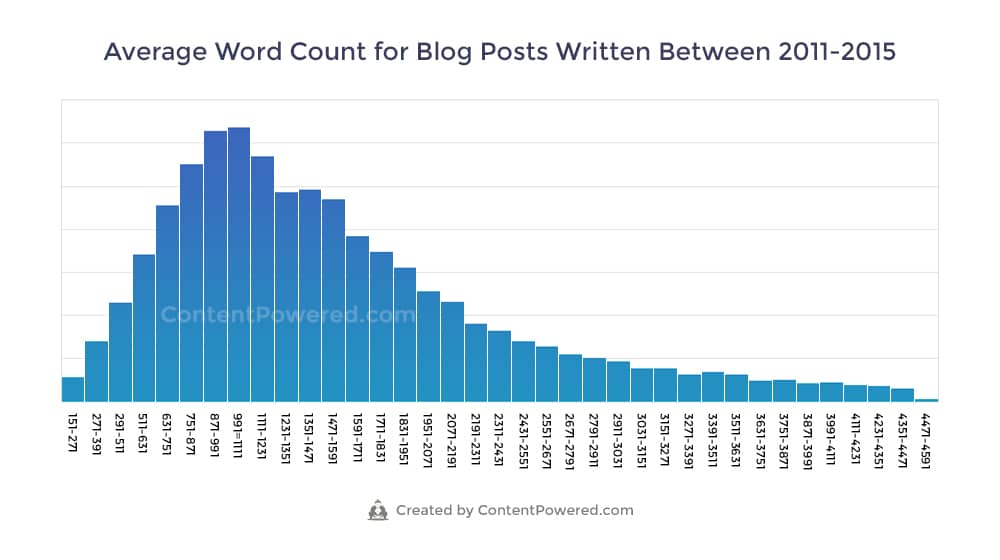
Here are some of the things I learned from this data:
- 31% were between 511 and 991 words
- 32% were between 991 and 1591 words
- 15% were between 1591 and 2071 words
- 11% were between 2071 and 2551 words
- 5% were between 2551 and 3151 words
- 2% were between 3151 and 3511 words
Not surprisingly, nearly a third of the 16,417 posts in this first data set were under a thousand words. The graph had a nice bell curve and the most popular word count range was 991-1111 words per post, followed closely by 871-991 words per post.
The average of these 16,417 blog posts in the 2011-2015 data set was 1,555 words. The most popular word count was 991-1111 words per post.
This number was a bit higher than I would have guessed, but considering that 65% of these blog posts had between 991 and 3511 words of content, it definitely bumped up the average quite a bit. If you're wondering how to track word count across your WordPress posts, that can help you benchmark your own content against these ranges - consistency and quality matter just as much.
Blog Post Length in 2019
The second half of this study is from a data set of blog posts that were written this year. Here are the results:
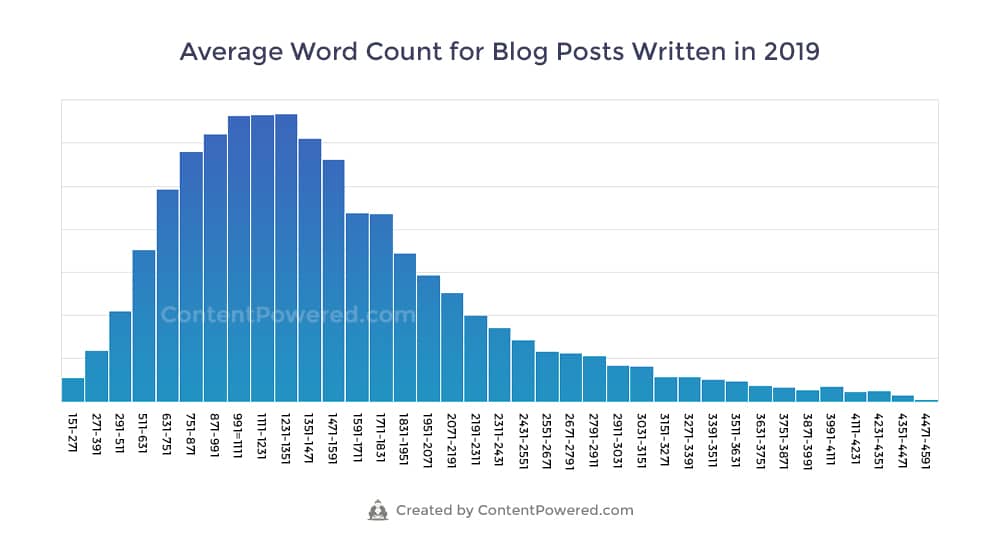
Here are some takeaways from this data:
- 23% were between 511 and 991 words (8% drop)
- 36% were between 991 and 1591 words (4% increase)
- 17% were between 1591 and 2071 words (2% increase)
- 8% were between 2071 and 2551 words (3% drop)
- 5% were between 2551 and 3151 words (No change)
- 2% were between 3151 and 3511 words (No change)
Shorter blog posts that were between 511 and 991 words saw a 8% decrease, which I attribute to thin or low value content being penalized by Google in 2011. Not surprisingly, slightly longer posts between 991 and 2071 posts saw a 4% and 2% increase respectively.
Interestingly, posts between 2071 and 2551 words saw a small drop, but long-form content between 2551 and 3511 words didn't see a change at all.
This bell curve seemed pretty close at the top, with posts between the 991 and 1351 word range being nearly identical in frequency.
The average of these 16,417 posts from the 2019 data set was 1,506 words. The most popular word count was 1231-1351 words.
I was surprised to see the average word length of these posts drop in 2019, but satisfied that the 53% of posts between 1000 and 2000 words saw a 6% increase. You can use a paragraph length checker to help optimize the structure of your content.
Posts between 3000-5000 words were far less common. However, our first data set happened to have more of those, despite them making up a low percentage of the overall data set. If you're concerned about whether certain content could get penalized, it's worth reviewing your posts for quality signals regardless of length.
Final Thoughts
That trend has continued. Recent data from 2024-2025 shows average blog post lengths have pushed even higher, landing somewhere in the 1400-1600 word range for most competitive topics. As for the prediction about hitting 1500-1700 words - we're basically there now, at least for content that ranks well in search results.
Competition for rankings has gotten fiercer, and search engines continue to favor comprehensive content that actually answers what people are looking for. A shallow 800-word post just doesn't cut it anymore in most niches, especially when your competitors are publishing 2000+ word deep dives on the same topic. If you're dealing with an e-commerce site, you may also want to look at common WooCommerce SEO issues that can hold your content back regardless of length.
Does this mean you'll have to crank out 2000-word essays for every post? Not necessarily. Quality still beats quantity when the content actually serves the reader. But if you're aiming to rank for competitive keywords, plan on giving your topics the space they deserve. A content optimization approach can help you gauge whether your posts are truly comprehensive enough to compete.
What are your thoughts? Will this change your blogging habits in the future? Let me know in the comments below!

Written by James Parsons
Hi, I'm James Parsons! I founded Content Powered, a content marketing agency where I partner with businesses to help them grow through strategic content. With nearly twenty years of SEO and content marketing experience, I've had the joy of helping companies connect with their audiences in meaningful ways. I started my journey by building and growing several successful eCommerce companies solely through content marketing, and I love to share what I've learned along the way. You'll find my thoughts and insights in publications like Search Engine Watch, Search Engine Journal, Forbes, Entrepreneur, and Inc, among others. I've been fortunate to work with wonderful clients ranging from growing businesses to Fortune 500 companies like eBay and Expedia, and helping them shape their content strategies. My focus is on creating optimized content that resonates and converts. I'd love to connect – the best way to contact me is by scheduling a call or by email.






November 19, 2019
Nice one James! Dang, this must have taken you a while to put together. Definitely seeing a large increase in articles written between 1000 and 1500 words. It's like you said at the beginning of your post though, this lets us know what we're up against. If 1500 is the new norm, I will have to start aiming for 2000+ 😉
November 19, 2019
Hey Paul, thanks for the kind words! Exactly, it gives us a good minimum of what to shoot for. More is better!
November 21, 2019
Great info, thank you for making this.
Nice to know I'm doing around the average (at least for now).
You've inspired me to step it up a notch though. Keep up the good work!
Thanks,
Marc
November 21, 2019
Thanks Marc! I'm glad, it's good to be ahead of the competition and aim to future-proof your content. You're putting hard work (or money) into them, so anything you can do to help them stand the test of time is smart, and all signs are pointing to long form content being the future, both in video and in blog post format.
December 03, 2019
Nice article James. Keep up the good work.
December 03, 2019
Thanks Adhyansh!
March 13, 2020
Wow this is very impressive work here, James. What prompted you to start this study? I can only imagine the cost and the time involved. You're a beast and I'm sure I'll be referencing this when my clients ask me why word count is important!
March 17, 2020
Thanks Alex!
Haha, well, most of the studies I've seen on word count are from years ago, so I thought it was time for a modern study 🙂
More importantly I was curious how the average word count has changed over time. Google Panda penalized thin and low quality content, so bloggers and marketers are starting to put more effort into their content, resulting in longer and better-written blog posts.
Feel free to share it as often as you'd like, I appreciate it!
September 11, 2020
Would it affect how the relevancy of your blog post if there are just too many words on the topic?
September 12, 2020
Hey Ryan! Good question.
This depends entirely on the content itself. If you stray too far off topic, it certainly good. Google has a very good idea on tangential and closely-related topics to the one you are discussing, so as long as you aren't too far off the reservation I can't imagine this would ever be a problem.
October 22, 2020
Nice work here! Can't imagine how many hours you work on it just to put this together. I usually write 1500-2k words on my blog post. Glad to know that it's the average
October 26, 2020
Hey thanks JD! Post-processing took a good while, though a lot of it was waiting for the software to do it's thing.. 🙂 thanks for stopping by!
January 06, 2021
Glad I caught this! I usually write 1000 words. Maybe it's about time to step up and create a longer post. Would you say if 2000 words is a pretty good start?
January 08, 2021
Hey Adrian!
Indeed, the more you can cover in your blog posts, the better.
You should never be writing just for the sake of meeting a minimum word count, but it's a great idea to make your articles as beefy and complete as possible.
It's also a good idea to see who's already ranking for the topic that you're about to cover (before you even start writing).
If the top position has a fantastic 3,000+ word post on the same subject, it will be harder to compete against that with a 2,000-word post.
Sometimes competitive research will give you a good idea of how much to write on a per-post basis.
This is why some of our articles are around 2,000 words and some are upwards of 4,000 words - it depends on the topic, the competition, and how much value we can cram into it.
January 21, 2021
Woah! You wrote a lot James! It might be out of topic but I am curious if for the past years you already have an ROI? I have a 1 yr old blog and writing1000-1500 words per article but it seems like I don't see any change yet.
January 22, 2021
Hey Nakia!
Ironically, this post has the lowest word count out of all posts on our blog 😉 thank you for the kind words nevertheless.
Yes, we're ROI positive. It happened within the first year for us.
We also dedicated some serious time and resources to our blog and those results are not typical for the first year of a blog.
The timeframe of when you become ROI positive can also depend on your industry.
Selling products or services will generate the most revenue. Dropshipping and affiliate marketing are in second place. Running ads will usually generate the least amount of revenue. Profit margins, average ticket, whether or not you have monthly subscribers or a free trial - all of these things are factors.
We are a subscription-based business and our clients are generally higher value, which allowed us to recoup our investment more quickly.
You likely need to focus on conversion rate optimization for your blog. Are you receiving a decent amount of traffic already?
This post may help you squeeze extra value and sales from your existing visitors:
February 05, 2021
Interesting. I think I should change my writing style so I can come up with a higher word per blog post. I usually have 800-1K words per article and I think I need to increase to 1500-2k words to keep up.
February 05, 2021
Hey Olga!
It never hurts to put more effort overall into your articles.
One thing that might help is to research the topic you're about to write about.
Count the words that your competitors used, the number of images, videos, and the overall quality of that article.
If your average competitor wrote 2,500 words on a topic and your article is only 800 words, it's pretty unrealistic to expect to compete with that.
Keep up the good work! The goal should be creating content that is so good that it's very difficult to compete with 🙂
October 04, 2021
Good stuff! This for sure took a lot of time to compose. What do you think will have a better SEO, having 1000 words per article published weekly or 2000 words every other week? Need your professional input on this.
October 15, 2021
Thanks, Annie. I appreciate that recognition!
It depends on the subject matter, competition, and industry.
Some blog topics are impossible to write more than 1,000 words, but in others, you can easily write 3,000 words or more and still have plenty to talk about.
Competition matters too - if everyone else who is writing guides and articles on those subjects is writing 2,500 words, then 1,000-word or even 2,000-word articles might not have a chance at competing.
In general, though, I think it's a better idea to write fewer higher-quality articles overall.
March 07, 2022
Wow, I admire the effort you put into this! Interesting results, too! Do you think people are leaning towards 2000 words these days?
March 09, 2022
Hey Frances!
Thanks for those kind words.
I think the concept of "10x content" is very dependent on the competition.
If the average competitor is ranking with 500-word blog posts, and you want a post that's 250% as good, you may only need to write 1250 words.
If it's a highly competitive topic with the average article clocking in closer to 2,500 words, then a 2,000-word article would actually fall short.
So, the competition of the topics you pick should align with the amount of effort you put into that subject. It's going to be very difficult to write a full 2,000 words with some topics. With others, you'll only be skimming the surface.