An SEO Agency Used AI and Ruined My Rankings - Help!
Written by 

AI is undeniably a powerful tool, but it has come with a lot of drawbacks.
- Rapid iteration on the technology has left early adopters struggling with substandard output.
- Public sentiment centered on recognizable generative content leads to reputational damage.
- High output and dense publication schedules trigger algorithmic content penalties.
- Vibe-coded tools can have huge performance issues, security implications, or accuracy problems.
It's entirely possible to use AI responsibly and effectively, but we all know that a lot of the fly-by-night operations that sprung up leveraging it very much do not do so.
I've been seeing an increasing number of businesses out there that hired promising-sounding SEO agencies that heavily used AI, and now they're suffering for it. Rankings drop, traffic drops, conversions drop, trust drops. All the while, the economy has been struggling too, making every hit hurt that much more.
If this has happened to you, what can you do to recover?
Key Takeaways
- Pause your SEO agency contract immediately to prevent further damage before investigating whether they caused the rankings drop.
- Ranking drops have multiple possible causes, including mass AI content, lost user trust, AI overviews, or completely unrelated technical issues.
- Delete zero-traffic AI-generated pages with no value, as they harm your site without contributing any meaningful ranking benefit.
- Recovery requires rebuilding EEAT through authentic stories, unique data, original visuals, and deep authoritative content AI cannot replicate.
- Recovery takes months since Google re-evaluates sites slowly, often only updating rankings during major core algorithm updates.
Step 1: Damage Control
The first thing you need to do is stem the bleeding.
Primarily, that means pausing your contract with the SEO agency that has been poorly using AI, so they can't do any more damage to you. Chances are, the damage is already done, but the more you can prevent them from doing, the less you have to clean up later. Before you do, it's worth reviewing red flags in SEO agency service agreements so you know exactly what you're dealing with.

Tip: Don't jump to pointing fingers. I've seen some SEO agencies get blamed for drops that were unrelated to what the agency was doing, and you don't want to burn a good relationship on an assumption. A pause is appropriate; a cancellation, an angry phone call, or a legal threat are not.
You should also take some time to look for any website backups you might have from before your rankings dropped. In the worst case, if you need to wipe the slate clean, restoring from an earlier backup might be the way to go. It's certainly a lot easier than nuking and replacing a bunch of content manually.
Step 2: Analyze the Reason for the Drop
The most important thing to do after any ranking drop is to figure out why it happened. If you suspect it's because your SEO agency overused AI and you got hit with an algorithm update, that may be true! It also might be a coincidence. I've seen more than a few small businesses panic, blame the first thing they see, and never really improve.
Broadly speaking, I've seen five main causes of ranking drops recently.
Highly focused content was replaced with generic content. This one happens surprisingly often, and I think it's a strategy some of these AI agencies are using to try to make clients dependent on them.
Basically, when this new SEO agency comes in, they do a content audit (or pretend they do) and then they go about making "content improvements" to existing posts. Unfortunately, these so-called improvements are anything but. They'll replace highly focused content with generic content, remove calls to action and useful data, and generally just make posts worse.
I've even seen these companies strip out recommendations for the client's own business and replace them with recommendations for competitors!
It's all about a lack of oversight. These SEO agencies want to use AI tools to take advantage of as many clients as they can as fast as they can, because the short-term gains are better than long-term relationship building in terms of the effort-to-reward ratio.
Mass-produced content saturated the site. The second big reason is just too much bad content too quickly. Google has always had rules against algorithmically-generated content, and AI content definitely falls under that banner.
If you hire an SEO agency and they're publishing ten posts a day, you can bet no real human is involved in that publication. In fact, I've even seen cases where you go through and find a bunch of near-identical content, or even pages that left in the AI responses! Think about how many products on Amazon have product descriptions that say something like "I cannot fulfill this request" or another AI form-response.
That's a death knell for a blog if it gets through. It's a 100% sure, clear sign that whoever is publishing the content is putting zero human review into it.
Users lost trust and stopped clicking through. This one is harder to diagnose and more insidious. A lot of people out in the world are fine with AI, or even love it. A bunch don't really know or care about what's going on with AI. But there's a sizable contingent of people who hate AI. And that contingent seems to be growing.
And it's not a small difference. When consumers recognize AI being used in brand marketing, they are four times more likely to distrust the brand. AI text, AI images, AI marketing in social media posts; it all just carries a kind of stink about it to people who recognize and dislike it.
It might not be a huge proportion of your audience that reacts this way, but it's still a loss, and it's not a loss you can easily recover. There are also common reasons visitors stop engaging with your CTAs that can compound this effect.
There are also two reasons why your rankings might have dropped that aren't necessarily anything to do with your SEO agency.
Simple topics were subsumed by AI overviews. AI is pretty good at extracting value and information from content. It's not excellent, and it can still make mistakes (the pizza glue incident comes to mind), but for simple knowledge-based queries and common information? AI overviews are taking over.

While Google is pushing AI overviews for anything they can, they're still most common in informational queries. Those used to be one of the best search intents to target for authority-building, but now they're mostly dead... in a sense. Why would a user click through to your site for information when the same information is in the AI overview?
The trick is, the AI has to get the information from somewhere. Instead of traffic, you're more likely to get an AI citation and a zero-click query out of it now. It's not nothing, but it's not as good as users who can click through and be exposed to your CTAs and other marketing.
Something unrelated. Believe it or not, for as much as AI has dominated marketing, it's not the only thing that matters. There are plenty of other reasons why your site might have rankings drop. Some might be related to something your SEO agency did, while others might be sheer coincidence.
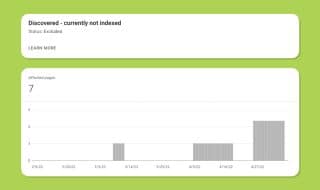
- A technical issue is preventing indexation.
- A bad script or other file is slowing down your site speed.
- A new good competitor popped up and is outdoing you.
- A major search algorithm update happened and hit you for unrelated reasons.
- A different issue cropped up, like a bad sitemap, bad redirects, bad canonicalization, or a bad robots.txt.
- A source of good backlinks disappeared or was penalized.
I've even seen cases where site owners think a big ranking drop happened, but it's just because they'd been on a long, slow decline and hadn't checked in ages, so the difference seemed stark.
Step 3: Examine and Audit Your Site
Once you think you've hit on the reason why you've lost rankings, it's time to audit your site and build a full picture of what has happened and what needs to happen.
A full site scrape using a tool like Screaming Frog is a good first step. Build a full index of pages on your site.

Pull your ranking data from your analytics platform of choice and add it to the sheet. Look for when the drop happened, whether it was gradual or sudden, and how much of a drop it was. This can help you figure out if it was just a few key pages that took a hit, or if your whole site was hammered.
You'll also want to look for all of the recently published, likely AI content and see how it has performed. Most of the time when I do one of these audits, I find that the SEO agency managed to land one or two nicely-ranking posts, but also published hundreds of posts that do nothing. No traffic, no rankings, no value.
The specific goals of this audit depend on why and how your site was hurt, and what you want to do about it.
Step 4: Decide on a Path Forward
You know what was affected, you know why you were hit (more or less), now it's time to figure out what to do about it.
Ditch the Bad Content
First up, all those AI-generated thin content pages that have zero links, zero traffic, and zero value? Just get rid of them. They're doing you no good, there's nothing of value in them, they're pure filler.

If, and this is a big if, any of them cover keywords you want to keep, you can keep the URLs and keywords handy and replace the content with better content. I usually find that purely AI-generated content takes enough work to improve that it's often not worth salvaging the text, but the URLs might be useful enough. It's really situational, though, and you might not gain much by worrying about it over just purging it and starting over. Deleting posts with zero visitors is often the right call.
Focus on EEAT
One of the big search ranking factors of the last half a decade or more has been EEAT. EEAT is Expertise, Experience, Authoritativeness, and Trustworthiness. It's basically the summary version of what Google trains its human search evaluators to look for.
It's also one of the main differentiating attributes that divides thin AI companies from legitimate companies.
EEAT is hard to pull off, but very important to aim for.

Your content needs to include something that promotes one of the four elements of EEAT, or more if you can.
- Authentic stories from your personal point of view.
- Case studies and unique data that only you could have.
- Original images, videos, and other content.
- Credentials and trust-building reasons why you're a good resource.
- Citations from recognized experts you build upon.
- Deep, authoritative dives into topics instead of just surface-level reviews.
- External validation from users, like reviews and valuable links.
- Your own experience on authoritative sites, from news sites to journals to interviews.
- Technical signs of trust, like NAP information, HTTPS, disclosures, and other details.
EEAT isn't built in a day. It can, however, be torn down in a day, which is where that AI-based loss of trust happens.
At its core, EEAT is about being authentic, valuable, and human. It's one of the slowest elements of SEO to build up, but you can at least make some changes to boost it in the immediate aftermath of a site audit.
Think About the Knowledge Gain
One of the biggest pitfalls of AI-generated content is that it is, by definition, derivative. AI cannot synthesize new information because it doesn't inherently have a concept of what information even is.
That's why AI overviews excel at summarizing and extracting information from knowledge bases, but fall off sharply when asked to create anything new and unique.
AI-generated content is often full of fluff, has nothing unique going for it, and doesn't stand out. After all, if your ten closest competitors are also using AI, all of you are basically producing identical content.
The way to get around this, I've found, is through knowledge gain. Knowledge gain is the unique information or perspective you bring to the table with your content. What sets you apart? What makes your content a better reference than the five or ten posts already ranking for the topic?
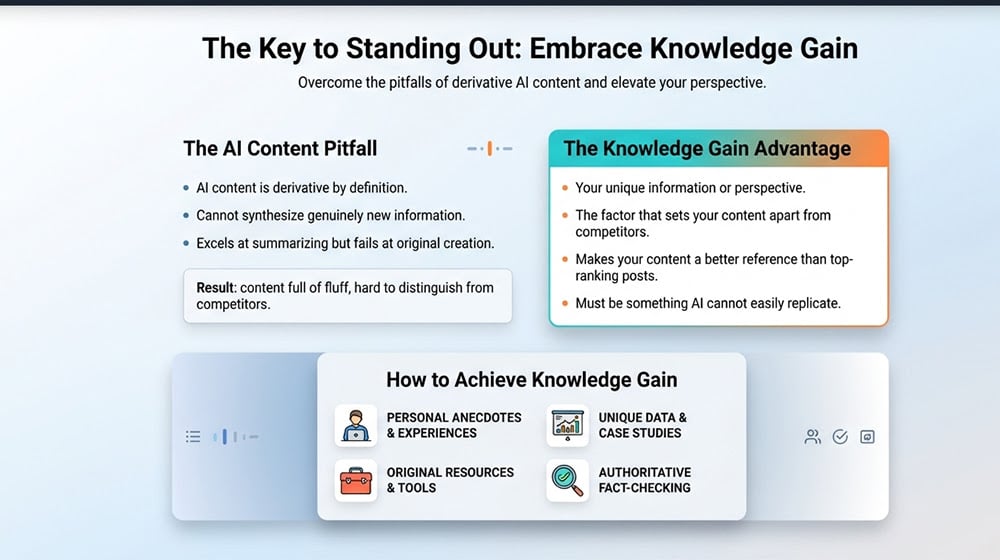
Moreover, these days, it needs to be something that AI isn't going to be able to replicate. You need personal anecdotes, unique data, case studies, resources, authoritative fact-checking, something. What it is specifically matters less than whether or not you have it.
Emphasize Non-Text Value
AI-generated text can look really convincing. Moreover, it only takes a little bit of work to take a basic AI-generated outline or shell content and turn it into something that looks and feels human, with some kind of knowledge gain.
All of that collapses if you use AI-generated images. AI images are still incredibly obvious. They rub people the wrong way. They stand out.

Some people view this as a problem to solve, to make AI better. Others, myself included, recognize it as an opportunity. If your competition is using AI to generate their images, you can stand out by not doing that. Even if you use stock photos, you're still a step ahead. If you use bespoke screenshots, composited images, or photography you commissioned, you stand out even more.
These days, users appreciate the genuine article, and that comes through most with unique visual content.
Consider a Contrarian Viewpoint
One last thing I want to mention is one that I'm still not quite sure about. I've gone back and forth on it.
AI is, in a way, a consensus model. AI overviews synthesize the common information from the top sources. Even in the underlying training data, AI is built by analyzing commonalities and replicating them at a syntactical level. The more common a construction is in language, the more likely AI is to generate it.
This has caused a ton of problems. All the writers whose work was used to train AI now have to change their writing habits because "they sound like AI" when it's really the other way around.
It can also make it harder to stand out. If five resources say the same thing and you say something different, the AI overview is going to copy the consensus, even if you're right. A lot of site owners I've talked to have tried to hammer out the differences so they can get their ranking, too.
And consensus can be important! Being contrarian for the sake of it isn't good by default. Ten out of ten doctors agree that you should drink water; you don't recommend avoiding water just to stand out.
I even wrote a post a while back about contrarianism in the age of AI, and one of my conclusions was that you lose out by being the odd one out, when AI summaries are recommending consensus-based content.

I'm starting to turn around on this a little. If your goal is to be in the AI citations, joining the consensus and adding to it is a good way to do it.
On the other hand, it's well-known that AI has a huge problem with being sycophantic. It's highly agreeable to the point that it causes all kinds of issues. AI is a consensus tool and will create consensus results.
If you want to stand out as something that isn't AI, then one way to do it is to go against the grain.
This is where the push-and-pull is very real, though. Consensus ranks, and contrarianism is a rocky road. But if you pull it off, you stand out much more from the pack, with a ton of knowledge gain.
I don't think you should be contrarian just to avoid the AI smell. But I do think, if you have real, valid reasons to stand against the consensus, it can be very valuable to do so.
Step 5: Put It All Into Practice
Basically everything up to this point has been analysis and theorycrafting. It's all essential work you need to do to recover from a major penalty, especially one caused by AI, but thinking alone isn't going to solve your problem.

So, what do you actually do?
- Remove the zero-value posts. If there's no value and no reason to keep them, don't.
- Flag good posts for improvement. Focus your efforts on the best 20% of your content to get the most growth right away.
- Identify and fix technical issues. Pay special attention to anything your AI agency touched, and make sure you aren't putting your weight on load-bearing slop or vibe-coded security flaws masquerading as plugins.
The exact specific fixes will depend on the specific problems your site has, of course. And, if you find that your underlying issue wasn't caused by your SEO agency, you can unpause your contract and work with them to fix the problems instead.
It's important to remember that AI is, at the end of the day, just a tool. It can't do everything for you, and it shouldn't. You need to establish at least a human oversight process, so you don't fall into the AI traps.
Unfortunately, the road to recovery is long and will take a while. Google isn't super responsive to these kinds of re-evaluations, and you might end up needing to work for months before another core update hits and recalculates you into a higher-ranking bracket. Keep at it, though, and you'll get there.

Written by James Parsons
Hi, I'm James Parsons! I founded Content Powered, a content marketing agency where I partner with businesses to help them grow through strategic content. With nearly twenty years of SEO and content marketing experience, I've had the joy of helping companies connect with their audiences in meaningful ways. I started my journey by building and growing several successful eCommerce companies solely through content marketing, and I love to share what I've learned along the way. You'll find my thoughts and insights in publications like Search Engine Watch, Search Engine Journal, Forbes, Entrepreneur, and Inc, among others. I've been fortunate to work with wonderful clients ranging from growing businesses to Fortune 500 companies like eBay and Expedia, and helping them shape their content strategies. My focus is on creating optimized content that resonates and converts. I'd love to connect – the best way to contact me is by scheduling a call or by email.