

What Are Some Cheaper Alternatives to the Ahrefs API?
Written by 
APIs are the secret sauce that powers a lot of what we take for granted on the modern internet. They're how data is funneled from app to app and how automation is constructed from the ground up. Platforms like Zapier are just elaborate, visual ways to connect APIs from different services in pre-defined ways.
For data-minded marketers, perhaps one of the best possible resources you could have access to is the Ahrefs API. Imagine: all of their incredibly powerful tools, all of their immense data and analysis, available to pipe directly into other apps and platforms you use… and even custom apps you develop yourself.
Well, Ahrefs knows what they have is a gold mine, so the ticket to ride is priced accordingly. All paid plans have some very limited access to the Ahrefs API, but you're limited to a few specific queries and a limit of 10-100 results for them, no matter what.
To get full, unfettered access to the Ahrefs API, you need the enterprise plan. The enterprise plan has a ton of great features, of course, but the buy-in of $1,500 per month is way too steep for most businesses.
And this is their newer setup. In their previous API version, the API Premium access cost $10,000 per month.
Let's be real here. Most of us don't have nearly this kind of budget just for an API, no matter how good the data on the other side happens to be. So, if you still want some kind of big data access, but you don't have a spare $1,500 per month floating around in the couch cushions, what can you do?
Managing Expectations
Before I dig into the alternative APIs you can use, I want to take a moment to manage some expectations.
Nothing is going to be a 1:1 reflection of the data Ahrefs gives you, API or otherwise.
It's not an exaggeration to say that Ahrefs has one of the largest data harvesting, scraping, and analysis systems in the world. Google is larger, and a few other companies are up there, but the numbers are immense.
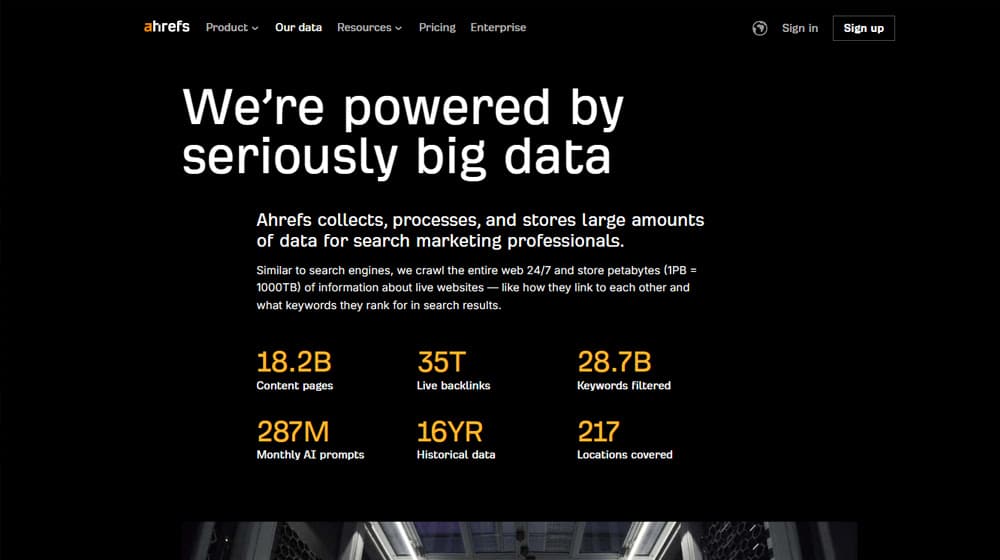
This means the data on the other side of the Ahrefs API is some of the most robust and, usually, best you can access. Any system larger than Ahrefs is either inaccessible externally or is highly limited, or is even more expensive.
All of this is to say that, when you're using an alternative API, you should set your expectations somewhere lower. You'll get data, but it might not be as robust, or as accurate, or across as many data points. After all, anything comparable to Ahrefs in data volume and quality is also going to be comparable in price, right?
The good news is, you might not need the scope and scale that Ahrefs offers. Most people who want to access the Ahrefs API are only going to be interested in a small fraction of what it has to offer. Smaller-scale data operations can get you good enough data for a much more reasonable price.
So, as long as you aren't operating at an enterprise level where hyper-accurate, large-volume data is required, you'll probably be fine with one or two of these alternative APIs. So, let's talk about what options you have.
DataForSEO
DataForSEO is one of the most frequently cited and commonly used SEO APIs on the market. It's a very modular API system, with a bunch of different data systems you can call. These include:
- SERP data
- Keyword data
- Backlinks data
- Domain Analytics
- On-Page SEO data
- Business data
- Merchant data
- App data
- Content Analysis data
- Content Generation data
- AI Optimization data
- DataForSEO Labs data
The last one there includes some of their smaller-scale databases that don't quite fit in another category. Things like Amazon data, Google Ads data, and Bing data live here.
Pricing for the DataForSEO API is pretty reasonable as well. It's a pay-as-you-go system that runs on credits, where the base price for credits is $1 for 1,000 of them. At higher spend levels, it's around half the cost. The only caveat is that there's a minimum monthly spend, but that's $50. The only outlier is the backlinks API, which has a $100 monthly top-up instead.
With so many different data sources and a flexible payment system to access them, it's no wonder that this is one of the most-recommended alternative APIs to the Ahrefs API.
As far as the quality of the data, it really depends on what you need and why. Some information isn't as accurate as you might like, while others are pretty spot-on. For a lot of these metrics, consistency is as important (if not more important) than total accuracy, so having context and using the same sources every time is the best option.
Bishopi
Another option you can consider is Bishopi.
As one of the many SEO-focused dashboards on the market, they don't particularly stand out, but they do offer a set of APIs to access their data on your own terms.
- SEO API with domain and page authority, traffic, keyword, backlink, and trust metrics.
- Backlinks API with backlink data, follow/nofollow ratios, data over time, and link profiles associated with link type and source authority.
- Traffic analysis API with visits, views, bounce rates, sources, and geographic insights.
- Keyword research API with keyword data, volume, competition, trends, gap analysis, and more.
Two things might stand out to you here. The first is that a lot of that data is derived data, which means there's already some analysis going on. There's nothing wrong with that, but it does mean that if you wanted to do the analysis yourself, you might need more sources of raw data.
The second is that a lot of those things sound a lot like other major SEO tools. Whether they're replicating the same data or just white-labeling those other tools, I couldn't tell you.
Bishopi uses a credits system as most APIs do. Most API queries use at a minimum 15-25 credits, and the starter plan costs $50 for 10,000 credits, monthly. Credits don't carry over; they refresh monthly, though if you buy extra top-up credits, those do carry over.
Majestic
Majestic is a big name in SEO through the power of being around forever. They basically invented certain backlink analysis metrics that are commonly used throughout marketing these days, and they maintain one of the biggest link indexes in the world. While they've added more SEO tools over the years, the links are still the core focus of both their normal service and their API.
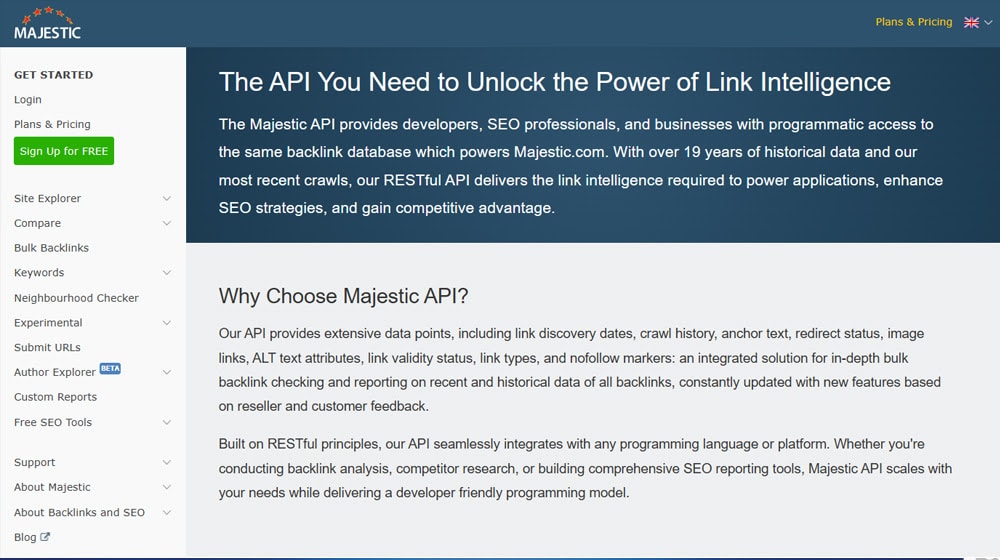
The upside is that they have, again, probably the single biggest and best link index out there that you can access. Their API also has two modes: you can access fresh index data, and you can access historical data from their 19-year history.
The downside, as far as SEO APIs go, is that this is still pretty limited. The link data is absolutely fantastic, but if you want things like keyword data, onsite SEO data, or other information, you'll still need to get it from somewhere else.
The other downside is the pricing. Majestic doesn't have an API-only plan; instead, their API plan serves the same role as an enterprise plan. It still includes all of their normal tools and data access, but adds in API access. If all you want is the data, paying for all of the tools is extraneous.
All of this is to say the lowest price you can pay for Majestic data is $400 per month, with additional plans that can run you up to $1,600 per month. It's still cheaper than Ahrefs, but that's not saying much when it's just a narrow slice of what you would want for comprehensive metrics and data.
SE Ranking
SE Ranking is one of my favorite alternatives to the big-name platforms like Semrush and Ahrefs when it comes to their normal product and dashboard, so it shouldn't be much of a surprise that their API is similarly good.
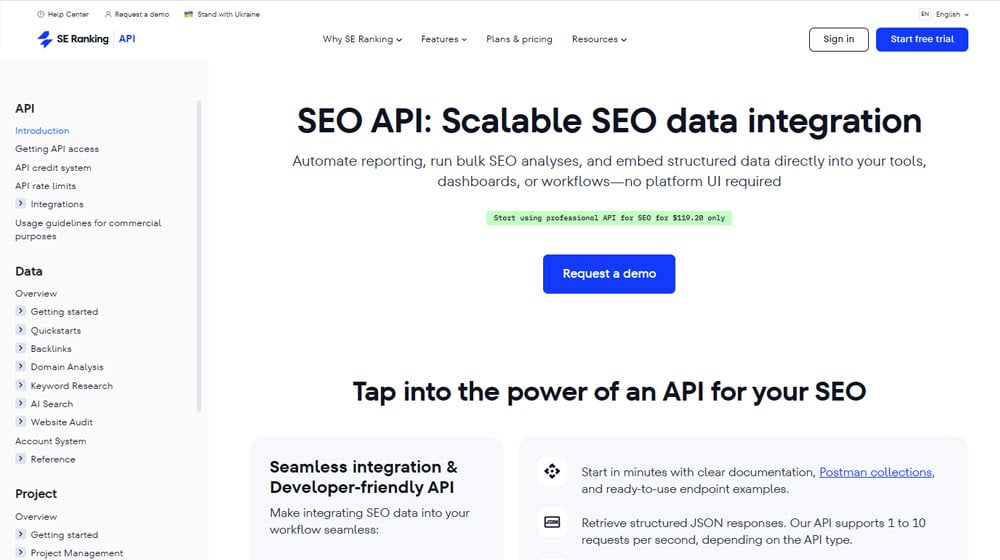
What kind of data can you access? A lot of the same general metrics you get with Ahrefs. They have:
- Basic keyword data
- Keyword research information, including volume, difficulty, CPC, and trends
- Backlink data (without analysis), including new and lost links, anchor text, and basic authority
- Domain analysis data, including organic and paid keyword data, traffic data, and ranking history for six years
- SERP data that can pull the top 100 search results for a keyword in real time
- Website audit data, including structured data and technical health reports.
Pricing-wise, they have a monthly subscription with non-carry-over credits similar to many other APIs these days. The lowest tier is $150 per month for a full million credits, and you can get 100k credits on a two-week free trial if you're unsure of the quality or utility of their data.
Credit usage ranges from one credit per record for backlink queries, to 100 credits per domain overview, to 1,000 credits per LLM call or complex task.
Semrush
Semrush is, in many ways, one of the most direct competitors with Ahrefs in terms of being the biggest and best SEO tool on the block. In fact, I wouldn't be surprised if a decent number of you who found this post were looking for Semrush API alternatives rather than Ahrefs API alternatives.
That's because Semrush API access is gated in a similar way as Majestic; that is, it's part of the high-tier business subscription rather than something you can get on its own. It's only available as part of the Advanced plan, which is $550 per month. But wait; that's just for access to the API. To use it, you also need API Units, which are an added fee per million credits (units) you buy.
The upside is that most of their API calls are relatively light on unit usage, so you can get Semrush data for analytics, projects, trends, listings, map ranking, and various other APIs for a fairly reasonable credit usage.
Still, a base price of $550 per month is pretty steep, even if you get more than what Majestic is giving you for a similar price point. Cheaper than Ahrefs, certainly, but that's not saying much.
Mangools
Mangools is another suite of tools that is pretty up there in terms of utility, and it's another one I recommend as a decent, lower-priced alternative to the big names like Ahrefs and Semrush.
Since Mangools grew out of being smaller, narrower tools, the API is a little behind on what it offers compared to the main tool and platform. Specifically, the API covers two of their main tools: the KWFinder and SERPChecker tools. It can give you data like search volumes, keyword suggestions, SEO difficulty, and more, all of which are stuff you would expect from those two tools.
Interestingly, they openly tell you that a good portion of their data comes from the Moz and Majestic APIs directly.
Mangools also has a pricing protection system built in. Any query you make is cached for 24 hours, so if you run another query that duplicates some of the data, you aren't double-charged for data that has already been pulled. This is useful if you tend to do a lot of your API work in the span of a couple of days.
One downside is that Mangools' pricing is obfuscated. They require you to send them a contact and describe your project and how much volume you need, and only then will they decide whether or not to offer you API access. I haven't needed it, so I haven't gone through the process myself, and I don't see much in the way of people leaking the pricing tiers either, so I couldn't tell you how much it will actually cost.
Moz
Surprising no one, Moz also makes the list. Interestingly, though, despite being one of the big names with a pretty sizable data index, Moz isn't priced like an enterprise-only tool. They even have a free plan just for the API!
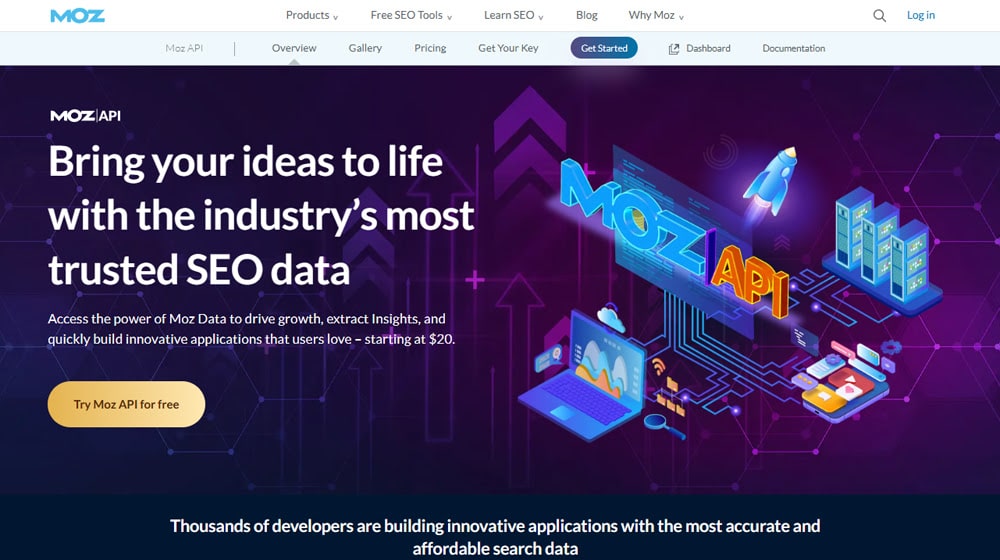
The Moz API offers a lot of the data you expect from using normal Moz tools.
- Keyword metrics like volume, difficulty, CTR, and more
- Search intent information based on keyword
- Related keyword information
- Brand authority analysis metrics
- Ranking domains for the top 50 results for a keyword
- Link metrics like domain and page authority, spam score, and link profiles
Moz runs on a volume of results rather than credits. Plans are limited to the number of rows you can receive, with the cheapest plan being $20/month for 3,000 rows. Certainly, they also have a huge enterprise plan that costs $10,000 per month, but gives you 40 million rows, but that's for top-end users. Most people opt for something in the 50,000 rows area, which is $125 per month.
Overall, Moz has great data, a flexible array of pricing structure plans, and a lot of good documentation. Higher-tier plans also have added benefits, like an overage rate for excess rows, and added rows specifically for low-volume beta testing queries.
SpyFu
SpyFu is another one of those tools that is pretty good, good enough for me to recommend, but it's not the top of anyone's lists. The API, though, is quite solid, with a lot of data that covers 1.6 trillion search results for the top 100 results per query, 8 billion keywords with detailed metrics, and a whole lot more. One thing they include that a lot of other APIs don't is PC ad data and historical information, which stretches as far back as 2007 for some domains.
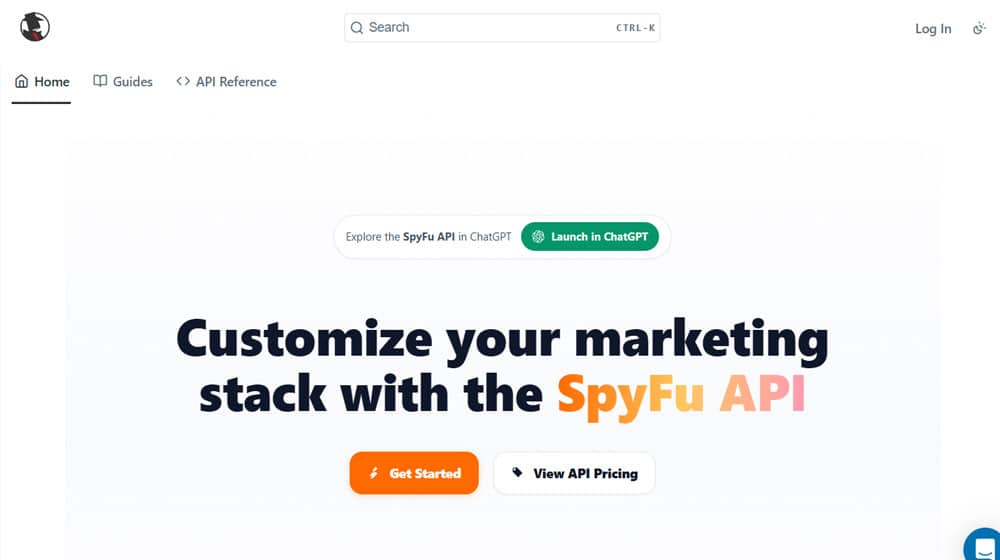
Overall, they have eight APIs:
- Domain Stats
- Ad History Research
- PPC Research
- SEO Research
- Competitors
- Kombat
- Keyword Research
- Ranking History
Kombat, in this case, is their competitive analysis via keyword overlap and gap analysis data.
Like Moz, SpyFu bills based on usage with rows output rather than some nebulous number of credits per different types of query. Unlike Moz (and like Majestic), API access is bundled with the mid-tier and up plans rather than being available on its own. That means you have to either have the Pro or Team account to access it. Pro is $120 per month (with a half-price first month), while Team is $250 per month.
Overall, it's a pretty good deal, but it's another case of buying a whole platform when all you want is an API, and that might not be what you want.
So, what do you think? Do you have other robust SEO APIs to suggest that I haven't covered here? Feel free to let me know!

Written by James Parsons
Hi, I'm James Parsons! I founded Content Powered, a content marketing agency where I partner with businesses to help them grow through strategic content. With nearly twenty years of SEO and content marketing experience, I've had the joy of helping companies connect with their audiences in meaningful ways. I started my journey by building and growing several successful eCommerce companies solely through content marketing, and I love to share what I've learned along the way. You'll find my thoughts and insights in publications like Search Engine Watch, Search Engine Journal, Forbes, Entrepreneur, and Inc, among others. I've been fortunate to work with wonderful clients ranging from growing businesses to Fortune 500 companies like eBay and Expedia, and helping them shape their content strategies. My focus is on creating optimized content that resonates and converts. I'd love to connect – the best way to contact me is by scheduling a call or by email.




Comments