

Triple Whale vs Northbeam vs Rockerbox for DTC Attribution
Written by 

Attribution is an important topic in marketing, but it's something often overlooked or taken for granted. On one side, you have fairly robust analytics, but on the other, you have increasingly strict privacy legislation and restrictions on data passing from one source to another.
We also live in a world where platforms, channels, and the routes customers take through them are muddy and unclear. If a customer first hears of you through a TikTok, eventually lands on a blog post, and makes a purchase, do you attribute that purchase to your blog or to TikTok? What if you throw in videos cross-posted between TikTok, Instagram, and YouTube? What if the customer didn't even watch them, but saw them referenced in a ChatGPT answer?
The basic attribution you get out of the box with platforms like Google Analytics can be fine when the stakes are low, but when you're optimizing for every tenth of a percent of conversion rate, you want an accurate picture of your user journey. You can't just be satisfied with last-touch attribution anymore.
Understanding Attribution Models
Before looking into specific platforms for handling attribution, it can be helpful to go through a refresher on the different types of attribution you might see, what their flaws are, and why you might want to use them anyway.
Here's what you should know:
- First Click. This model of attribution gives credit to the source of a customer entering your marketing ecosystem, whether it's a TV commercial, a banner ad, an affiliate click, or a TikTok video. It's good for measuring awareness and demand generation, but nothing else.
- Last click. This model of attribution gives credit to the most recent interaction prior to a conversion. It's the easiest to track, but it undercuts 99% of your marketing efforts; it's like measuring the whole economy based entirely on the junk mail you get in your mailbox.
- Linear. Linear models track the user journey from first to last click and give each touchpoint equal weight. Good for mapping a user journey, bad for understanding which touchpoints have the most influence.
- Time Decay. A linear model with a weight that gives more value to the more recent touchpoints. Useful in niche circumstances, but rather arbitrary and incapable of analyzing the value of each contact.
- Positional. A hybrid of First, Last, and Linear. Most weight is given to the first click (to measure awareness and demand), and to the last click (to measure effective conversion marketing), with some weight given to touches in the middle. More reasonable, though it still loses a lot in the middle.
- W. Similar to positional, but with a third weighted element in the middle, usually the point where a lead is qualified, or an aware user turns into a lead.
- Algorithmic. These use machine learning to analyze your conversions across the board, develop an overall awareness of where touchpoints have the most and least value, and give you deeper insight. Very powerful, but requires significant volume and can feel very "black box" in how they work.
- Iterative Testing. The gold standard using A/B testing to determine the true value of each touchpoint. Extremely accurate, but very slow and time-consuming to gather relevant data.
When you're shopping for a DTC attribution tool, you want one that can provide several different models of attribution, including the most useful of them for your specific use case. It doesn't do you much good to invest in algorithmic modeling if you only have a dozen conversions per month. Time decay isn't useful if you're mostly an impulse, first-sight business. They all have their pros and cons, after all.
Three of the most common DTC Attribution tools are Triple Whale, Rockerbox, and Northbeam. I figured I'd give each of them a rundown and discuss why you might use one over another.
Northbeam
Let's start with Northbeam.
Northbeam is designed to be heavily focused on machine learning, with multi-touch attribution and media mix modeling using as much data as you can give it to draw the most accurate possible conclusions. It has integrations by default with a wide range of marketing platforms, from social media (Facebook, X, TikTok, and more), ad networks (Facebook, Google, Microsoft, Amazon), and marketing platforms you might be using.
I also give Northbeam a lot of credit, specifically for this page. A lot of companies in the marketing space have started using AI as an umbrella buzzword, meaning anything from algorithmic analysis to generative content creation to agentic service. Northbeam doesn't cover their platform in AI stars and claims, and in fact goes into a deep discussion of the differences between the umbrella AI and the narrow ML.
This is great because blindly throwing LLMs into the mix means an inherent risk of hallucinations that can destroy the validity of your data. Northbeam acknowledges and circumvents this risk.
Northbeam pulls in data from a lot of sources and manages a handful of powerful models for attribution, so it can give you a very useful picture of your overall marketing ecosystem. It also has fast-refresh data sources and can keep your data accurate up to the hour.
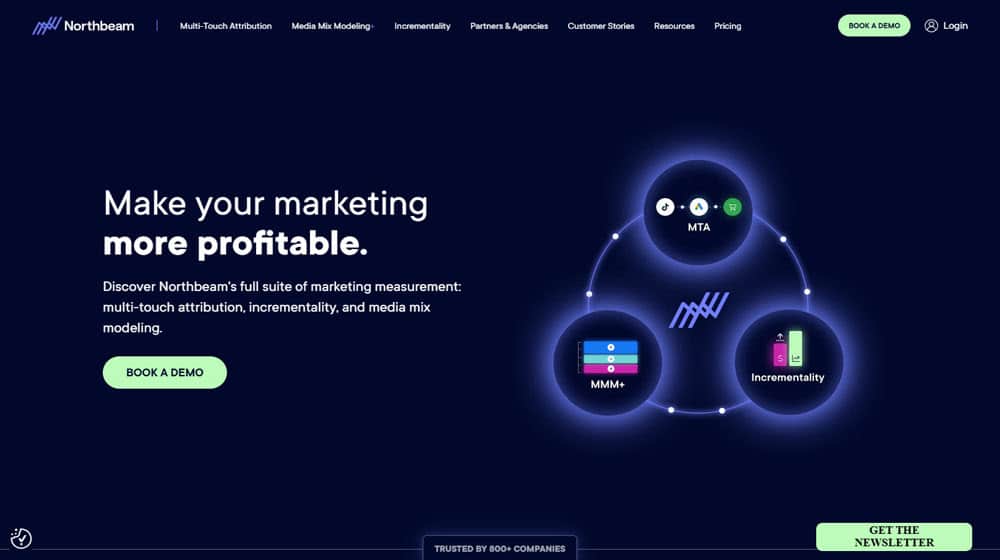
Northbeam is undeniably powerful, but it has a few drawbacks.
For one thing, while it has a lot of integrations, there are still many more that aren't natively available. There are ways you can feed data into the platform, but unless you're willing to build that custom solution, you might find your information limited outside of the most popular attribution channels.
I will say that, by all accounts, if you want an integration that they don't have, you can request that they add it, and their devs are pretty good at doing so.
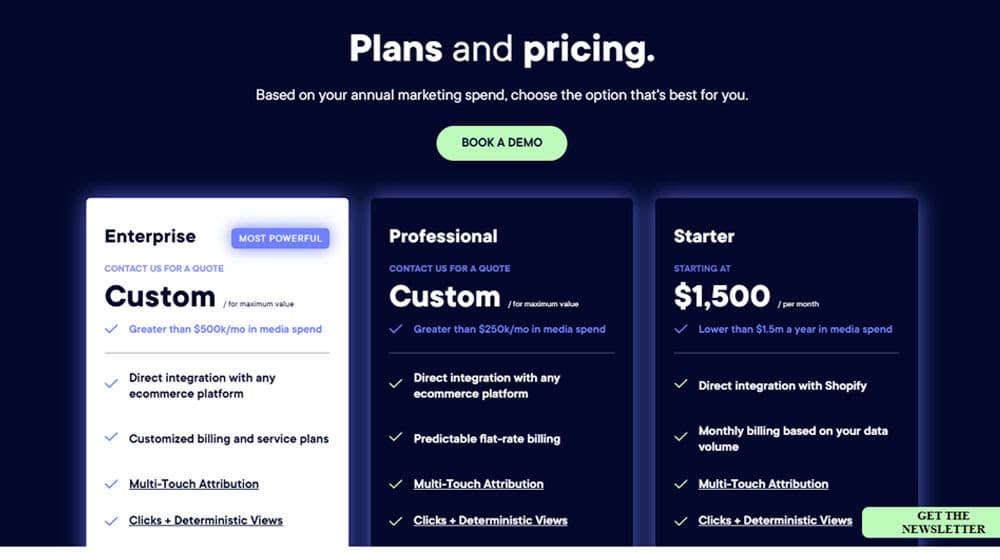
For another, Northbeam is very much focused on high-performing, high-value brands. Their "starter" plan is for any business spending less than a quarter of a million dollars per month on advertising across all channels.
That's reflected in the pricing, which they've pushed more over the years. Used to be, you could get in and use Northbeam for $300/month. Now, the starter plan is $1,500 per month. Small business service this sure isn't.
Don't get me wrong; it's an incredibly powerful platform. It just knows it, and knows who wants it. If you're that scale of enterprise brand, it's going to be extremely useful. If you're operating on smaller budgets, it's more… aspirational.
Rockerbox
Rockerbox is designed to give as many different forms of attribution as it can, with MTA, MMM, and iterative testing being the big ones. All data is processed through their proprietary systems (of course) with full infosec certifications for sensitive data.
In addition to their integrations pulling data in, they are also very open about pushing data out. In other words, you aren't forced to keep logging into the Rockerbox dashboard for your reports; they can push data to your internal warehouses and allow you to manage it through your own custom dashboards or other systems, in whatever way you like.
Where Northbeam might struggle to pull in data from all of your marketing channels, Rockerbox has a vast array of integrations, with over 100 available out of the box. They readily work with social media, search channels, advertising and affiliate data, programmatic sources, and even direct mail and television.
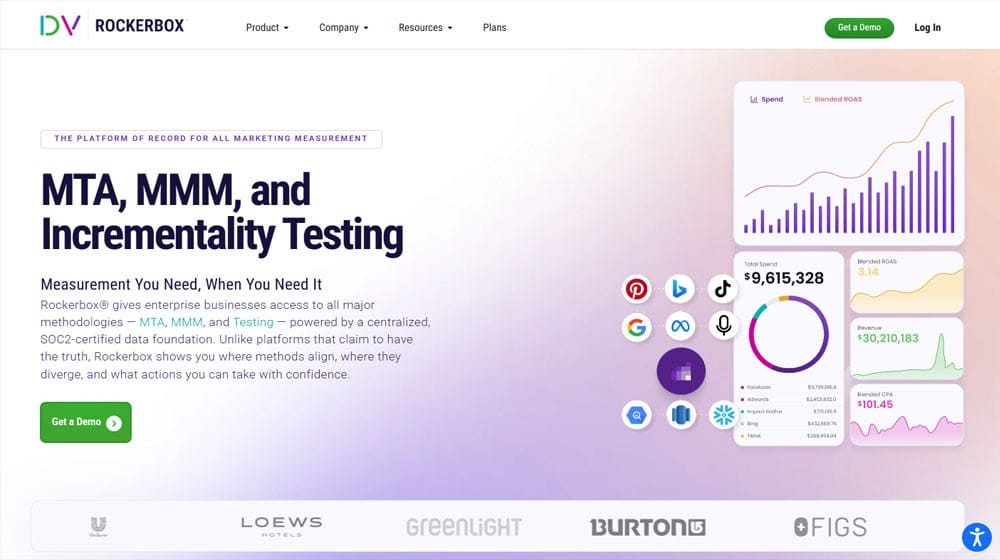
Overall, Rockerbox is one of the best I've found if you're operating in a few specific kinds of spaces. Retail brands that leverage as broad a footprint as they can, in particular, are very well-served. They're also very good at tracing attribution from difficult sources, like podcasts, influencer marketing, and mail.
If you're the kind of business that loves getting hands-on with data, Rockerbox is great for you too. They're very transparent with their attribution models, and while it's all deeply technical information, it's solid gold if you're the kind of technological gearhead that views these complex systems as catnip.
The flip side is, it's a little less useful if you're not that kind of person. They expect you to know how to analyze and interpret the data they give you, so it's easy to just not leverage the platform for what it's worth.
All of the above might make this sound like another high-end enterprise attribution platform, but it's surprisingly not. While they hide pricing behind requesting a quote, I've seen mentions of anywhere from $150-$300 monthly as a starting point. It's quite accessible and a good option for early investment that can grow alongside you.
Triple Whale
Triple Whale is at once designed for small-scale businesses and enterprise firms. They set a standard of enterprise-grade attribution service, but their pricing and accessibility make them a powerful option for surprisingly small-scale stores. In fact, they're often recommended as the best attribution platform for Shopify businesses just dipping their toes into attribution at all.
Triple Whale is fully compliant with CCPA and GDPR, and they maintain SOC II security, though that's true of most of these attribution platforms.
One potentially nice feature of Triple Whale is seamless data connections. When you want to connect to a source of data, be it a social network, an ad platform, or something else, they probably already have it set up and easy to implement. You don't have to go and painstakingly map data points or manage your own processed warehouse.
My hesitation here is that, unlike Northbeam's nuanced take on machine learning, Triple Whale is all-in on AI. Sure, they have their own agentic framework (called Moby, natch) and claim it's not just ChatGPT being fed your data. But. Is it?
They aren't transparent about the AI, and do you want to stake your attribution data on a black box? They claim to use a "combination of cutting-edge language models," but then mention OpenAI prioritizing security. I'm skeptical.
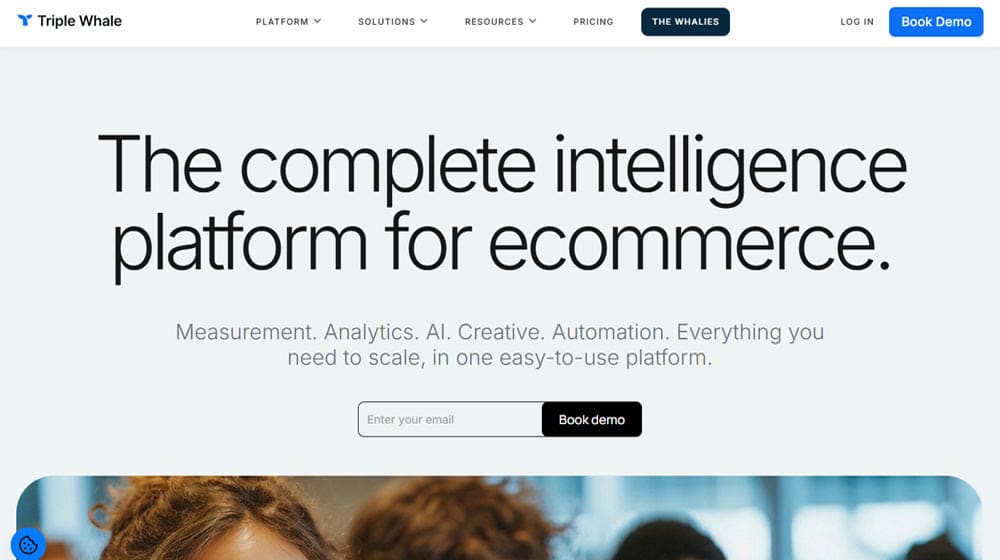
In my view, how much use you get out of Triple Whale depends on a few things.
- First, how large is your brand? While Triple Whale is effective for surprisingly small businesses, it shines most at larger scales. Pricing starts at $150 per month for sub-250K GMV brands, and they even have a free plan, though the free plan is rather limited.
- Second, how much do you want to use and trust agentic AI? If you're squeamish or hesitant with AI, Triple Whale very much isn't the platform for you. If you're fine with it, or you're good at double-checking and verifying AI conclusions, it can be a good assistant.
- Third, how broad is your marketing ecosystem? Triple Whale works best when you have a lot of different sources, so smaller brands focused on just two or three aren't going to get the most out of it.
Triple Whale also has a series of add-ons that cost extra on top of the basic platform. These include conversion, retention, and a unified measurement model, which add to the cost overall. They also have a credits system for chats with their LLM agents, which can eat up additional funds if you're big into using them.
Alternatives to the Big Three
These three are some of the most common DTC attribution platforms, but they're far from the only players in the space.
What are some of the others you could consider?
- Cometly. Cometly is substantively similar to Triple Whale in being an AI-first attribution platform. It's more focused on data sources from e-commerce platforms and does less with alternative marketing channels, and aims for a more mid-market audience of brands willing to pay $400/month to start.
- Growify. Growify is another mid-range DTC attribution platform, aimed at mid-sized businesses starting to push for larger spaces. Pricing starts at $300 per month and scales based on your monthly visitors, which can be surprisingly strict depending on how your marketing works. Brands with broader-scale, less-focused marketing can get more use out of it. It does focus more on just a couple of attribution models, though, so it may not give you the specific insights you want.
- Socioh. Socioh is a Shopify-native attribution platform offering a free first-party pixel to Shopify users. It focuses on multi-touch and weighted attribution models, and while the pixel and certain analytics are free, pricing starts at $600 per month for the full platform. It's limited to certain channels, too, and doesn't include models like incremental testing or channels like TV.
- Fospha. Fospha is a weighted DTC attribution app that focuses on the awareness and demand generation part of the funnel. In other words, it tends to use weighted or first click models the most. It's quite expensive for those limitations, too, starting at $1,500 per month.
There are other options out there, too, so feel free to explore the space. And, if you have a recommendation for me, let me know in the comments.
Why No Low-Budget Option?
This is an interesting question. How come there aren't any attribution platforms that run with sub-$100 pricing and work for small businesses?
Mostly, it just comes down to the fact that they aren't that useful at the small business scale. When your data is a few new data points each day, rather than hundreds per hour, there's really not much you can draw from them. Your smaller marketing budget also limits how many and how deep you can go with your marketing channels, which makes attribution simpler.
Basically, if you can't afford the lower-end attribution tools, you probably aren't in a position to get anything truly useful out of them anyway. These are tools used by businesses taking the step from small to medium or trying to push from medium to large. Growth hacks they are not.
If that suits you, great! My recommendation would be Rockerbox as a more entry-level attribution platform, while Northbeam is incredibly powerful if you can afford it.

Written by James Parsons
Hi, I'm James Parsons! I founded Content Powered, a content marketing agency where I partner with businesses to help them grow through strategic content. With nearly twenty years of SEO and content marketing experience, I've had the joy of helping companies connect with their audiences in meaningful ways. I started my journey by building and growing several successful eCommerce companies solely through content marketing, and I love to share what I've learned along the way. You'll find my thoughts and insights in publications like Search Engine Watch, Search Engine Journal, Forbes, Entrepreneur, and Inc, among others. I've been fortunate to work with wonderful clients ranging from growing businesses to Fortune 500 companies like eBay and Expedia, and helping them shape their content strategies. My focus is on creating optimized content that resonates and converts. I'd love to connect – the best way to contact me is by scheduling a call or by email.






Comments